How consensus works
How /consensus and /ask-* keep models honest
This section uses the Claude Code command names, and "Claude" means the host agent that orchestrates the run. On other hosts your own agent plays that role through the consensus-step tool (or the server plays it with consensus), under the same rules.
/ask-gpt, /ask-gemini, /ask-grok, and /ask-all are the quick commands: each dispatches one or three external models, Claude reads the output, and you get one synthesized answer. Single shot, no loop, no peer round.
/consensus is the heavy one. Same parallel dispatch, but with a peer-review round and a multi-round loop that stops only when the models agree. The cost: the orchestrator (Claude) writes the review prompt, casts a vote, decides which objections are real, and runs the loop. Left alone, that setup can quietly rubber-stamp its own plan. Four guards stop that.
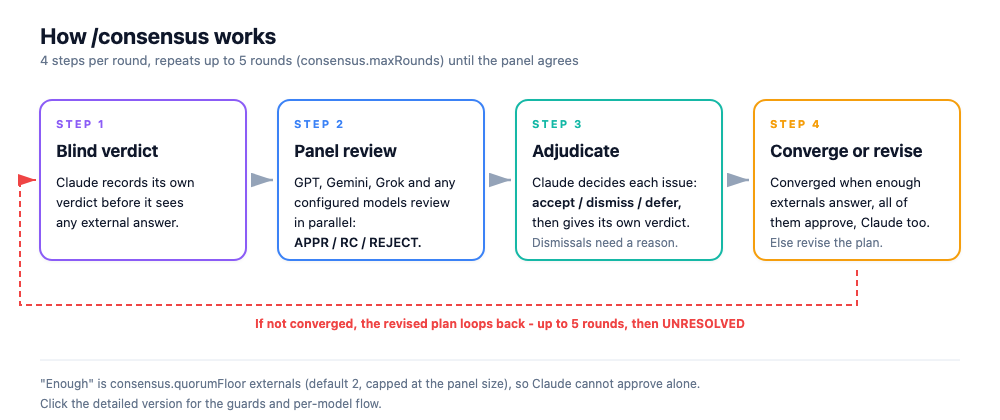
See the detailed diagram with bias guards and per-model flow
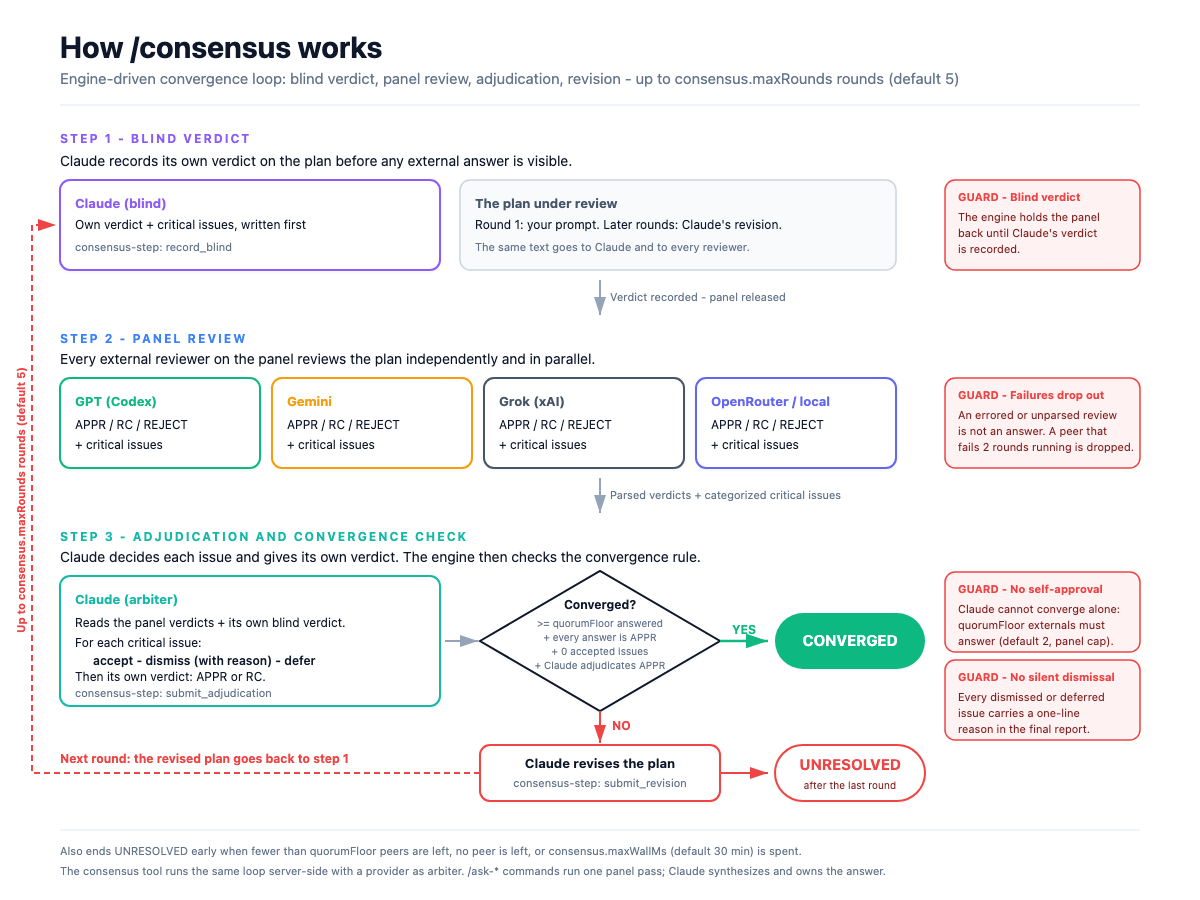
The four guards:
- Blind verdict. Claude posts its own verdict (APPROVE / REQUEST CHANGES / REJECT) in a message sent before the one that calls the panel. The pre-commitment sits in the transcript, so Claude cannot reshape its opinion after seeing the others. The engine enforces this: the panel is not revealed until the blind verdict is recorded.
- Peer review. Each external model reviews the plan independently and returns a verdict plus categorized critical issues; Claude weighs them as the arbiter. The models vote, Claude adjudicates.
- No self-approval. A round converges only when every responding external approves and at least
consensus.quorumFloorexternals actually answered (default 2; a panel smaller than that needs every member to answer). Claude's own approval never carries a round by itself. A provider that errors (an unconfigured Grok returningmissing-auth, for example) drops out of the count instead of jamming the loop. - No silent dismissal. Every critical issue that gets dismissed or deferred ships with a one-line reason in the final report, including the times Claude walks back one of its own blind objections. The engine rejects an adjudication that dismisses an issue without a reason.
The /ask-* commands carry a lighter version of the same rule. The external model only advises: Claude reads the output, applies its own judgment, and owns the synthesized answer. When the models agree, that is input, not a verdict.
Every delegate prompt also carries today's UTC date and a rule against calling an unrecognized model, tool, or version non-existent from memory: a model trained months ago marks such a claim [unverified] instead of filing it as a critical issue. Looking up the actual facts stays with Claude, which has tools; Grok and OpenRouter have none. See TECHNICAL.md.
Deep dive: how a single /consensus round actually runs
/consensus is a thin driver over the core convergence engine (core/consensus-loop.js); the loop mechanics - round counting, the convergence rule, the configurable max-rounds cap, history, and the confidence label - live in the engine, not the command. Each round:
- Blind verdict. Claude commits its own verdict (transcript-visible) BEFORE the panel is revealed; the engine gates the reveal on it.
- Panel review. GPT, Gemini, Grok (and any configured OpenRouter delegates) review the plan in parallel and emit APPROVE / REQUEST CHANGES / REJECT plus categorized critical issues. The server parses each verdict.
- Arbiter adjudication + revision. Claude reconciles the panel verdicts and its own blind verdict; for each critical issue it picks accept, dismiss (reason required), or defer, then revises the plan for the next round.
The loop converges when at least consensus.quorumFloor externals respond (default 2, capped at the panel size), every one of them approves, none reject, zero critical issues remain accepted, and Claude adjudicates APPROVE - so Claude cannot self-approve. It otherwise stops at consensus.maxRounds (default 5, configurable) as unresolved. The confidence label reflects how fast it settled (round 1 = high, 2-3 = medium, 4-5 = low).
A round only pays for voices that can still answer: a peer that fails 2 rounds running is dropped from the panel (reported once as droppedProviders, then never dispatched again), and the whole loop stops at consensus.maxWallMs (default 30 min) rather than starting another round. Both apply on every driver. See TECHNICAL.md.
The same engine backs the entry points other hosts use: the consensus tool (runs the whole loop server-side in one call with a provider arbiter, or a single synthesis pass with synthesizeAlways:true) and consensus-step (drive it yourself, one action per call). See TECHNICAL.md for the taxonomy and the engine contract.
An earlier revision ran an extra "Stage 2" anonymized peer cross-review (each model scoring the others' answers blind, adapted from karpathy/llm-council (external)). The engine-driven rewrite removed it to keep one source of truth; it may return as an engine feature.